What value does the world need most right now? Peace, perhaps. Compassion? Respect? Hope? Justice? Courage? Trust?
Ask the question in London and you may get one answer. Ask it in Lagos, Mumbai, New York, Manila or Melbourne and you may get another. But what might happen if we brought people from those different places together — not simply to talk about values, but to do something about them?
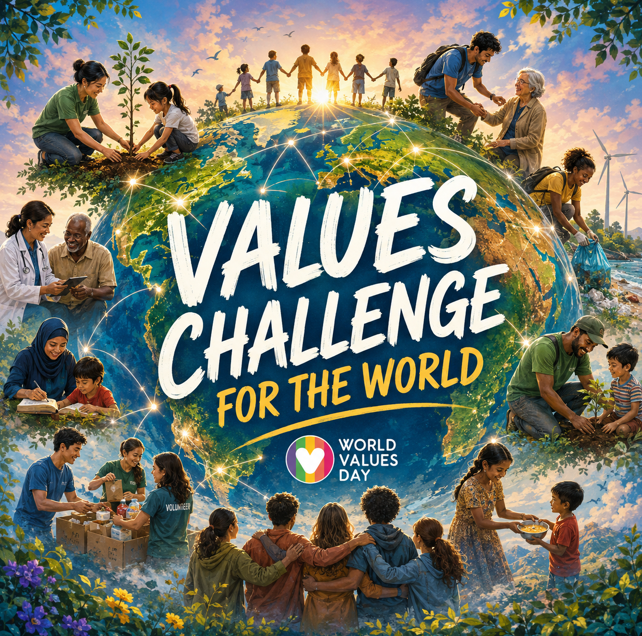
That is the idea behind a new World Values Day experiment: the Values Challenge for the World. On 1 October, World Values Day will hold two one-hour online workshops, timed so that people from different parts of the world can take part. Beforehand, participants will be asked which values they believe the world most needs right now. One value will then be selected as the focus for each workshop.
And then the interesting part begins.
From words on the wall to actions in the world
The new workshop has grown out of the Values Challenge, one of World Values Day’s longest-running initiatives. The original Challenge was developed by the UK Values Alliance with the Forward Institute, the RSA and PwC as a simple one-hour exercise for organisations.
Its premise was straightforward. Many organisations have impressive statements of values, but everyday reality does not always live up to them. That distance between what we say matters and what we actually do is known as the “values gap”.
The Values Challenge was designed to do something about it: One Hour. One Value. One Change. A group chooses one value that needs attention, considers where practice falls short and agrees one practical action that will bring the value more fully to life.
The idea has proved remarkably durable. Over the years the Challenge has expanded to schools and community groups as well as many hundreds of organisations, with participants ranging from multinational companies to small businesses and local groups. Now we want to find out whether the same simple idea can travel further.
A different kind of room
There is an obvious difficulty. People working in the same organisation have something important in common. They know the same workplace, operate within broadly the same culture and can agree to change something together. Put four strangers from four countries into an online breakout room and none of that applies.
But perhaps that is not a weakness. Perhaps it is the most interesting thing about it.
Imagine discussing compassion with someone thousands of miles away whose circumstances are quite different from yours. What does the value look like from where they stand? Where do they see it flourishing — or missing? And what might their experience teach you about your own?
The Values Challenge for the World will deliberately make space for those different perspectives. Participants will first reflect on what the chosen value means to them personally and where they see a gap between that value and what happens in the world immediately around them.
Then they will go into small international groups with one deceptively simple question:
What is one simple action that people in many different parts of the world could take to bring this value more fully to life?
The emphasis is on what we can do — not what governments should do, what business leaders should do, or what other people ought to do.
One action, many expressions
The answer has to be simple. It also has to be broad enough to work across very different countries, cultures and circumstances. Suppose, for example, the chosen value was hope, and the shared action became: Give someone a reason to feel more hopeful.
One participant might encourage a struggling colleague. Another might contact a lonely neighbour. Someone else might mentor a young person, thank a volunteer or share a story about something going right in their community. The action is shared; how it is expressed is personal.
And there is one final twist. We will ask each participant not only to take the action themselves, but to consider how they can encourage someone else to do something too. We call this Ripple Around the World.
One action will not change the world. But values are rarely brought to life through grand declarations. They become real through the accumulation of ordinary actions: how we speak, listen, help, include, encourage, challenge, forgive and care.
That has always been the principle behind the Values Challenge. Values have to become everyday habits and behaviours rather than attractive words on display. On 1 October, we are going to find out what happens when we take that principle out of the organisation and into the world.
One Hour. One Value. One Action.
Where the ripple goes after that is up to all of us.