Hope can sometimes sound rather passive. We hope things will get better. We hope someone will do something. We hope that somehow the world will become a kinder, fairer and more peaceful place.
But what if hope is something we do?
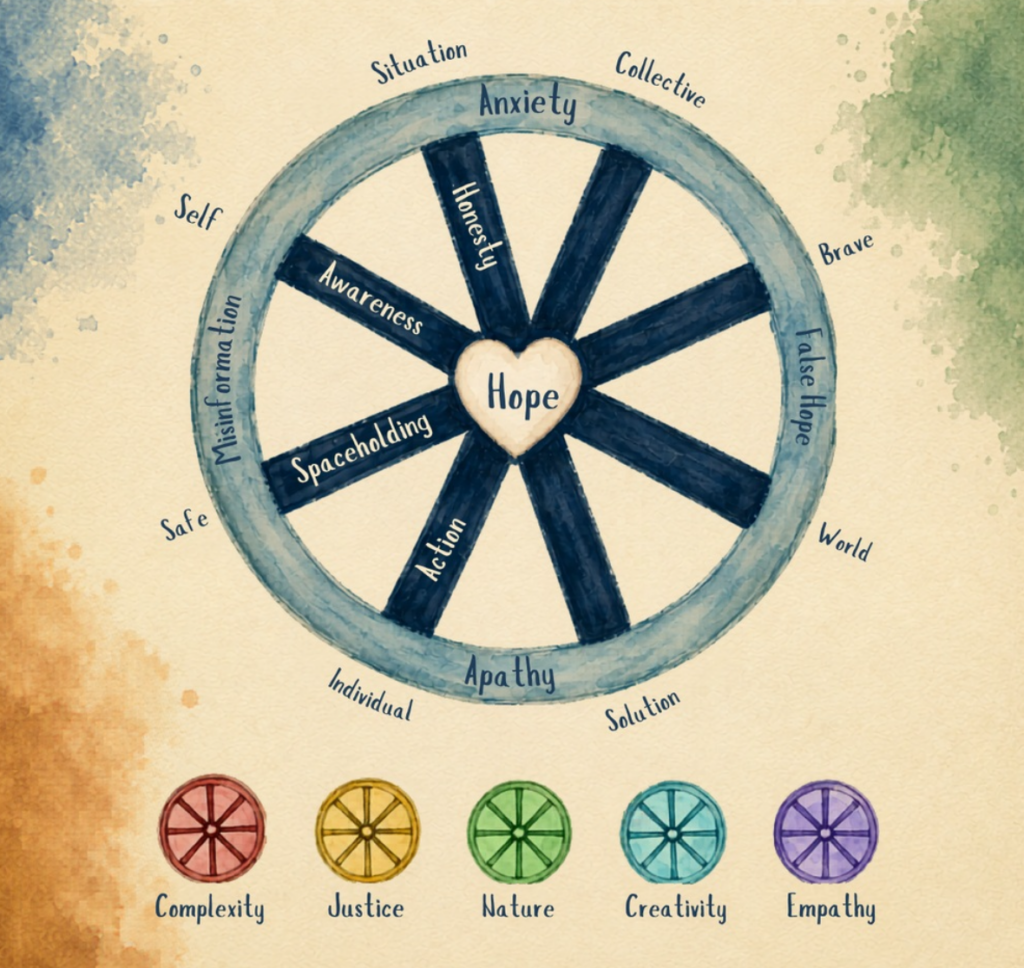
That is the thinking behind the Hope Wheel Guide for World Values Day, a simple but powerful tool that can help us explore what matters to us, understand what matters to others, and turn those values into action.
For World Values Day, William Finnegan of the University of Oxford and Cathy d’Abreu of Oxford Brookes University have created a practical Hope Wheel Guide that anyone can use — on their own, with another person, or as part of a group. It invites us to reflect on our values, connect with the values of others and consider how our actions can contribute to a kinder, fairer world.
At its heart is a familiar World Values Day question: What are the values that matter most to me — and what am I going to do about them?
The Wheel offers four “handrails” to help us answer that question: Honesty, Awareness, Spaceholding and Action. We begin by identifying a value we care deeply about and being honest about why it matters — and perhaps why we sometimes find it difficult to live up to. We become more aware of the values of people around us. We make space for the emotions connected with those values. And then comes the crucial part: we act.
That action does not have to be dramatic. It might be a message to somebody who needs encouragement, a favour for a neighbour, giving someone a listening ear, or volunteering some time to a local organisation. Small actions matter — and small actions have a habit of leading to bigger ones.
The Hope Wheel also encourages us to look beyond our own perspective. Its five “lenses” — complexity, justice, nature, creativity and empathy — invite us to look again and more deeply. What tensions might there be between different values? Whose voices may have been left out? How might things look from somebody else’s point of view? Could we find a creative way of putting our values into practice?
There is serious research behind this apparently straightforward exercise. Finnegan and d’Abreu developed the Hope Wheel by bringing together insights from psychology and education. Their 2024 paper in Frontiers in Psychology describes hope not simply as a feeling that things will turn out well, but as something that can help us engage constructively with difficult realities and move towards action.
This matters because hope is not about pretending that everything will be all right. The Wheel itself warns us to watch out for false hope, anxiety, apathy and misinformation. Hope, in this sense, is not passive optimism but an active practice: seeing the world as it is, recognising that change is possible, and deciding what part we can play in bringing it about.
There is another reason why sharing our values matters. Research highlighted in the Guide shows that many young people care deeply about kindness, fairness, other people and the planet, yet mistakenly believe that their peers do not feel the same way. When we think our values are not shared, we may be less likely to act on them.
When we talk about what matters to us — and, better still, do something about it — we make our values visible and encourage others to do the same.
That makes the Hope Wheel particularly appropriate for this year’s World Values Day theme, Values and Volunteering. Volunteering, whether it is an informal act of kindness or a sustained commitment to a community or organisation, is one of the most direct ways of turning the values in our hearts into something that makes a difference in the world.
So why not try the Hope Wheel for yourself?
Open the Hope Wheel Guide, choose a value that really matters to you and work your way around the Wheel. Do it on your own, with a friend or colleague, or as part of a group. Talk about what you discover. Listen to what matters to others. And then choose one thing — however small — that you will do to bring your value to life.
You can also watch the short Hope Wheel explainer video to see how the Wheel works.
Hope does not have to mean waiting for a better world. It can mean recognising the values that matter to us, discovering that others share them, and acting together to make a difference.
Start here: explore the Hope Wheel Guide and turn your hope into action.
#WorldValuesDay