
If you wanted to run a marathon, you wouldn’t just turn up at the starting line and hope for the best. You would train. You’d stretch, lace up your trainers, clock up the miles, and gradually build your endurance. The same applies to almost every other walk of life. Whether it’s learning to drive, playing chess, or making fresh pasta from scratch (that’s one I am working on), we accept a universal truth: if you want to be good at something, you have to practice.
Yet, when it comes to our deepest values—the moral compass that guides how we live and treat others—we often treat them as static. We assume that because we ‘have’ values, they automatically remain active, healthy, and fit. But values are like muscles. If you don’t exercise them, they can atrophy. If we want to be our “best selves”, we need to give our values a regular workout. As we look ahead to World Values Day this October, which carries the vital theme of Values and Volunteering, there is no better time to recognise that volunteering is a fabulous training ground for keeping your values fit.
The Layer Cake of Who We Are
In a world dominated by market transactions, it is easy to forget what actually holds society together. I’ve always been fond of an economic model created by futurist Hazel Henderson back in 1982: the “Layer Cake” model of an industrial society.
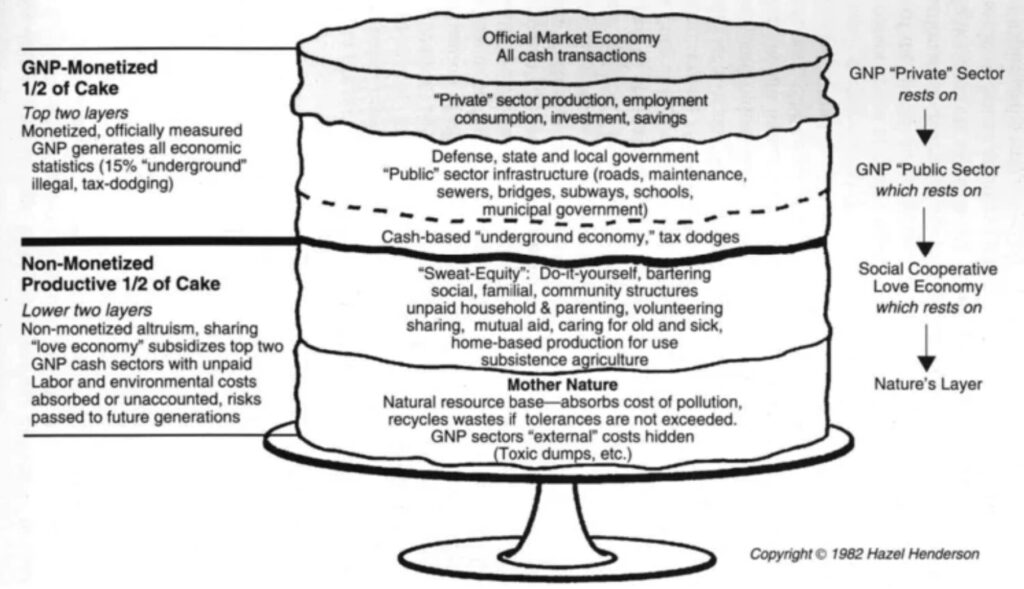
At the top is the monetised economy—the cash transactions, the private sector, the official statistics. But that top layer doesn’t float in mid-air. It rests entirely on a non- monetary lower half: the social economy and civic society of sweat-equity, mutual aid, parenting, civic care, and volunteering. And underneath that, Nature.
Volunteering is quite literally the social fabric holding the world up. It represents a different operating system from the marketplace. While markets grow consumers, volunteering grows citizens. When we step into the voluntary sector, our internal motivators shift. We move away from the external drivers that the commercial world amplifies—wealth, power, social status, and image. Instead, we step into a space fuelled by intrinsic values: dignity, curiosity, empathy, and fairness. By volunteering, we choose to spend time in an environment where these values are the currency.
Why do people take that step? When we look at primary motivators for volunteers in the UK, the data tells a beautiful story. The top value drivers are community pride (49%) and altruism (46%), followed by personal connection and social cohesion. Often, people begin volunteering for individual reasons—perhaps an internal desire to learn something new, have a say, or simply enjoy a shared social life. There is a wonderful phrase by Sally Bailey, the former Chair of Pilotlight—a skills- based volunteering charity that I had the privilege of leading as Chief Executive up until 2025 —who captured this perfectly: “Helping others helps me to feel better myself.”
What is fascinating, however, is the transition that happens over time. As you show up week after week, your collective incentives grow. What might have started as a personal hobby transforms into a deep, shared commitment to a community and a common goal. You realise that you aren’t just giving your time; you are getting back an incredible return on your values. Part of this is about learning – what used to be classed as “soft skills” are now recognised as essential ‘Power Skills’— such as empathy, collaboration, communication, and critical thinking.
A landmark study by the Wellbeing Research Centre at the University of Oxford looked at workplace wellness interventions across hundreds of organisations and over 46,000 workers. They reached a striking conclusion: standard wellbeing interventions largely fail to improve employee mental health—with one single, positive exception. That exception is employer-supported volunteering. As Dr. William Fleming noted, volunteering offers a “win-win model of wellbeing that is more collective and relational.” It makes us happier because it connects us.
At a local level, I see this values-workout in action every single week in South London. As Chair of RUSS (Rural Urban Synthesis Society), a volunteer-led community housing co-op, I work alongside ordinary citizens who have co-designed London’s largest 100% affordable community housing scheme to date. Following my transition last year into a portfolio of voluntary roles, I have also been able to see this power on a national scale as a trustee of Charity Excellence. Through this online platform, which supports a network of around 100,000 users across the charity sector, I am constantly reminded of the sheer impact of small, voluntary organisations. They are the engine rooms of civic life, powered entirely by people exercising their values under pressure. At the same time of course, a passion for values can sometimes turn into fights about values. Handling conflict constructively is one more part of the training we all need.
Lace Up Your Boots
Volunteering isn’t a luxury or a side-hustle for when we are bored. It is an essential practice for staying human. Whether you are part of the ‘silver backbone’ of consistent formal volunteers aged 65–74, or a member of Gen Z driving a new surge in informal, grassroots volunteering, your contribution matters.
This October, as the UK Values Alliance and citizens across the globe celebrate World Values Day, I challenge you to look at your own schedule. Don’t let your values sit on the shelf gathering dust. Find a cause that stirs your heart, join a local trust, or help a neighbour. Step out, lace up your boots, and give your values the workout they deserve.
Ed Mayo MBE is a member of the UK Values Alliance, and author of Values: how to bring values to life in your business (Routledge).